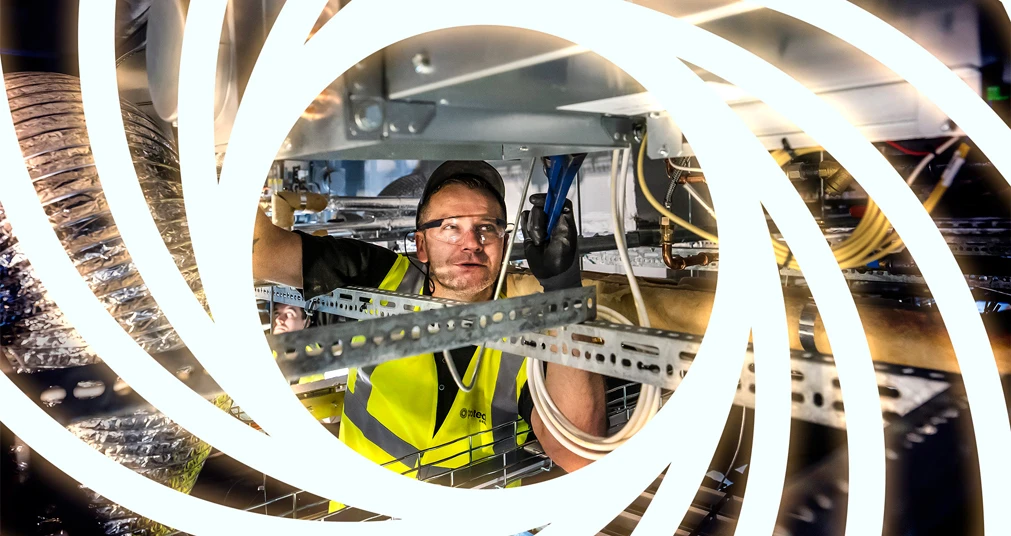
Heating up, cooling down Air conditioning (AC) use in non-domestic UK buildings, including offices and retail spaces, has been gradually…
Heating up, cooling down
Air conditioning (AC) use in non-domestic UK buildings, including offices and retail spaces, has been gradually increasing. More significantly, AC systems are now increasingly delivering the primary heating load, reshaping how the technology is perceived, specified and integrated within commercial buildings.
AC is now a heating-led technology
Air-to-air heat pump technology, which integrates air conditioning and heat pump functionality, has come a long way in recent years. Modern A2A HPs are quieter to operate, more compact and compatible with smart building management systems, making them well-suited for non-domestic buildings where heating efficiency must be aligned with building design.
In the UK, Air-to-air heat pumps tend to favour year-round heating mode, with cooling used as a secondary option due to the nature of the cooler climate. This is especially pronounced in Scotland, where cold winters demand near-constant heating.
In non-domestic applications, Air-to-air heat pumps typically achieve seasonal efficiencies of three to five times that of traditional electric resistance heating, depending on building design, usage patterns and operating conditions.
Exploring common misconceptions
For years, AC has been seen as a cooling-only solution which has held facility managers back from embedding the solution into wider, efficient heating strategies. The technology is also often associated with luxury-only commercial operations based in hotter climates, but this simply isn’t the case.
Another misconception is operating capability in colder weather. Older AC units have historically struggled to maintain capacity in colder temperatures, but modern low-ambient models use vapour injections and defrost cycles to maintain 80-100% of operating capacity in temperatures as low as -20°C. And while the UK’s winter can seem to last forever, thankfully, we experience significantly milder temperatures than these extremes, meaning AC units can continue to operate unaffected and efficiently.
The operating costs of AC in non-domestic settings is also widely misunderstood. It is impossible to calculate a one-size-fits-all cost for the running of an AC unit. The exact cost depends on the capacity of the unit, energy prices, usage hours and the setup’s efficiency.
Dedicated expert energy solution companies, such as Protech, will guide you through the process and each associated cost, step-by-step.
Why AC works well in retrofit environments
Air-to-air heat pumps work exceptionally well in a variety of settings and circumstances. This is largely because they distribute heat via air rather than water, removing the need for pipework, radiators or major building alterations. In retrofit environments, the technology is simpler to install compared with traditional wet heating systems, brings less disruption to the building fabric and is a stronger fit for older commercial and heritage buildings. This versatility is the goal for any non-domestic heating system and makes future planning more straightforward.
Where AC fits within wider decarbonisation programmes
AC systems integrate well with solar PV and battery systems, which are used to power the setup during the day while batteries store excess energy for use during the evening. The technology can also reduce reliance on gas by replacing gas boilers with electricity-driven heating.
That’s one of the reasons why AC should heavily feature in estate teams’ long-term heating plans. Not only does the technology offer dual heating and cooling capabilities to improve climate resilience, but the systems also ensure net zero compliance through low-GWP refrigerants and scalability across portfolios.
An AC-powered future
It’s understandable that after years of misunderstanding, the concept that AC is not just for cooling is difficult to embed into practices overnight. But by re-evaluating AC as a modern heating solution, organisations can get ahead of changing legislation and future-proof current heating setups. Improving comfort, lowering emissions and modernising older estates is integral to improving the heating fabric of non-domestic buildings across the UK.
What to expect from changes to commercial MEES in 2025
Article
4 min read
The Minimum Energy Efficiency Standards (MEES) play a critical role in governing the environmental performance of commercial properties in the...
What To Consider When Upgrading Boiler Plant Rooms For Manufacturing Sites
Article
4 min read
UK manufacturers are under pressure from all sides. On the one hand, they need to decarbonise to meet government targets...