Why the cooling and pipework behind the racks is where the engineering really counts. Demand for data centre capacity in…
Why the cooling and pipework behind the racks is where the engineering really counts.
Demand for data centre capacity in the UK continues to grow, and the conversation around it is usually about power: where the grid connection comes from, how much capacity can be secured, and how long it takes to secure connection. That’s a real constraint, and it deserves the attention it gets.
But once a site is powered, the engineering problem that determines whether it can run smoothly tends to be a mechanical one. Every watt drawn by the racks leaves the building as heat, and moving that heat away reliably, continuously and at scale is what the mechanical scope exists to do.
What does the mechanical scope cover?
In broad terms, the mechanical scope starts with chiller plant on the roof or in an external compound, which produces refrigerated water. That water is distributed through large-diameter pipework which drops down through the building and into the data halls, where it draws heat away from the racks before returning to be cooled again.
Described that way it sounds straightforward, and in principle it is. The engineering sits in the scale, the tolerances and the consequences of getting any part of it wrong. The distribution needs to carry the design flow to every part of a hall without imbalance, accommodate the plant it serves, and continue to perform as load is added over the life of the site.
Why is cooling the core challenge?
Aside from a loss of power, cooling failure is one of the fastest routes to downtime in a data centre. Hardware in a densely populated hall generates a great deal of heat in a confined space, and the margin between normal operation and thermal shutdown may be measured in minutes rather than hours.
That places the mechanical design alongside the power supply in terms of criticality, and it means resilience must be designed into the mechanical system in the same way it is designed into the electrical one. Redundancy in the plant, in the distribution and in the routes those services take through the building should be considered a core part of the specification.
What standard does the pipework need to be built to?
Pipework is often treated as the least interesting part of a mechanical package. On a data centre it is one of the most consequential, because it’s the element that is hardest to correct once the site is live and running critical load.
That places weight on the fundamentals: correctly sized large-diameter distribution, the appropriate pipe grades and materials for the system and its operating conditions, properly considered supports and expansion, and welding carried out and certified to the relevant standard. Certified in-house welding is vital here because it keeps the quality of the joint, and the accountability for it.
It also counts at handover. Pressure testing, flushing, water treatment and commissioning records are what demonstrate the system will perform as designed, and they are considerably easier to produce properly when the installation has been built with them in mind from the start.
What changes as rack densities increase?
Rack densities have been rising, and workloads associated with AI are accelerating that. Air cooling has practical limits, and as those limits are reached, cooling is shifting towards liquid, bringing the cooling medium far closer to the hardware itself.
For the mechanical scope this represents a significant change. It alters the flow and temperature regimes the system needs to deliver, increases the importance of water quality and system cleanliness, and pushes more distribution into the hall itself, where the tolerance for leaks and for disruption during future works is far lower.
It also raises questions about how much of a site’s future is designed in at the planning stage. Some operators are building for liquid cooling from the outset; others are seeking to retain the option without committing to it. Both are legitimate positions, but they lead to different distribution strategies, so it’s a decision better taken deliberately at design stage.
Can the system be maintained while it’s live?
A data centre is not built to be switched off, which makes maintainability a core design decision. The hardest constraint isn’t installing the distribution in the first place; it will be repairing, isolating or extending it later without dropping existing cooling to live load.
That points to designing the distribution so sections can be worked on while the rest of the hall keeps running: sectional isolation valves, provision for bypasses, and tie-in points for future capacity built in from the outset. A leak repair, a valve replacement or an added load can then become a contained piece of work on an isolated branch. Like the redundancy in the plant itself, this is far easier and less disruptive to design in at the start.
Where does the mechanical scope stop?
It’s important to be clear about the boundaries. Power, grid connection and backup generation are separate disciplines with their own specialists, and they sit outside the mechanical package. At Protech we deliver the cooling and the pipework: the plant, the distribution and the mechanical infrastructure that moves heat away from the racks.
Where those disciplines meet is often where risk accumulates on a project, so knowing precisely where one scope ends and the next begins is worth establishing early. As part of DCC Energy GB, we work alongside group businesses covering generation, on-site renewables and fuel, which can make those interfaces easier to coordinate where a client wants them handled together.
What should you be asking a mechanical contractor?
The useful questions tend to be specific ones.
- What comparable systems have you built, and at what scale?
- Who carries out the welding, and to what certification?
- How will the system be commissioned, and what records will we hold at handover?
- How will works be sequenced around a live site, and what happens to cooling capacity while they are carried out?
Behind each question sits the same principle. In a data centre, the mechanical infrastructure is one of the systems the site depends on to stay online, so it deserves to be specified, delivered and interrogated on those terms.
Protech Group maintains and installs heating, ventilation, cooling and water systems UK-wide, with directly employed engineers. Tell us about your site and we’ll scope the right approach.
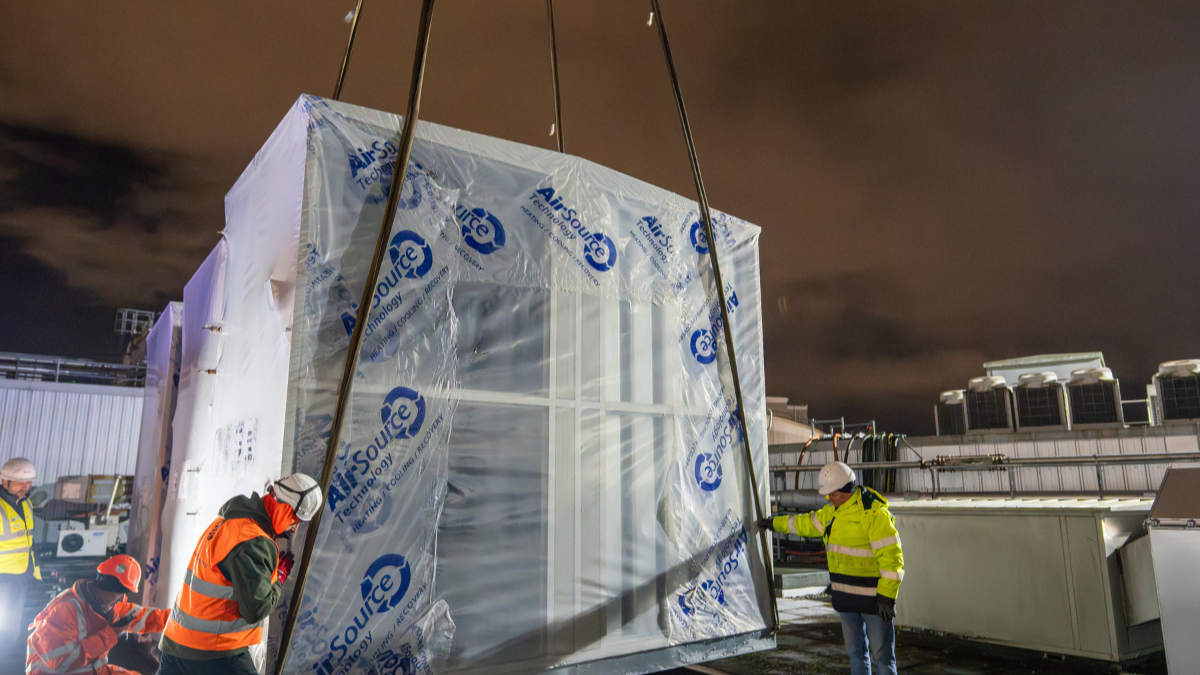
AC’s New Frontier: Heating in Commercial Properties
Article
4 min read
Heating up, cooling down Air conditioning (AC) use in non-domestic UK buildings, including offices and retail spaces, has been gradually...

What to expect from changes to commercial MEES in 2025
Article
4 min read
The Minimum Energy Efficiency Standards (MEES) play a critical role in governing the environmental performance of commercial properties in the...
What To Consider When Upgrading Boiler Plant Rooms For Manufacturing Sites
Article
4 min read
UK manufacturers are under pressure from all sides. On the one hand, they need to decarbonise to meet government targets...